Monday, 5 November 2012

Chapter 4


VISITING RELATIONS IN NEWCASTLE

    On one occasion we went by train to Newcastle to visit my Grand-patrents. The compartment was full of soldiers going home on leave. They told us that they were stationed at 'DEATH CAMP'. They called it that, because it was in Cemetery Road, Gravesend (or so they said).
    A train attendant came round selling packets of potato crisps from a large wicker basket, with a leather strap. This was the first and only time during the war that I experienced a packet of crisps. There was no choice of flavours, make, or anything like that, and the salt was separate. It was screwed up in a little square of dark-blue paper which was hidden away in the bottom of the packet. There was only one brand available, and that was 'Smith's Crisps'.
    My Grandparents in Hebburn-on-Tyne, near Newcastle. They had a young sailor billeted with them, and he kindly took me on a tour of his ship, which was being worked on,I guess it was undergoing a refit in one of the yards on the bank of the River Tyne. I remember it well, it was a hive of activity, and very noisy too; especially from the riveting and hammering. The River Tyne is so very different now to what it was then. I think the shipyard (of which there were several) in question was called Hawthorn-Leslies. I saw pairs of workmen fitting red hot rivets into place with tongs, and then hammering them into place (very noisy), and I also saw and learnt a bit about 'caulking', when workmen sealed the decks with tarred string. I imagine now that I was rather lucky to have been allowed to go on board a warship, especially during war-time.
    In a recent conversation with my aunt, who still lives in what was my Grandparents house, that, according to her, they and other neighbours had several sailors staying with them, and she thinks that particular ship, the one mentioned above, may have been the 'Agincourt', which was a 'Battle class' destroyer, but searching on the ionternet doesn't back that up, although she was built at Hawthorn-Leslies's shipyard. However she added another interesting little aside to my 'memoirs', which involves me, on what must have been a much earlier visit to the North (1938?) and which reads as follows:-
    My parents liked to be overly prim, and proper, and fought shy of referring directly to such unmentionable subjects as the toilet, or anything to do with it. They had adopted the practice of referring to the need for the toilet, especially a No. 2 job, as us children wanting 'ATTENTION'. This I had grown up with.  Only, in my simple child like mind I had always thought the phrase was: "A TENSION". Apparently we were all sat round the meal table, and the news came on the radio. The newscaster announced dramatically that: "A tension has spread all over Europe".
I was horrified. I raised my hands still clasping knife and fork, and with mouth half full, and cried out: "Yuck ! TENSION! That must be terrible!" And it was from that point on that my mother explained to me that there was another way to refer to one's natural needs, and that perhaps I could, and should, in future use the term "toilet'.
My grandparents' small terraced house already had a lodger (the sailor), the sleeping accommodation was all taken up, and there was no room for me. So, I was shipped over the River (across the Tyne on the ferry - I can even remember my mother chatting with the cheerful ferryman) to stay with another aunt, who lived in Whitley Bay. There I had three cousins, and I had a super time with my aunt (I had four aunts and seven uncles in my mother's family). We children went down onto the beach and combed the shore. We found coal, and a large leg of ham! How did that get there? We also took buckets to collect winkles, which my aunt boiled, and we ate. I didn't like them that much, and they were rubbery, and fairly gritty with sand. I think the public was allowed access to the beach, but it was limited to two hours. Unlike at home, in Kent, where could not get near the beach at all, as it was all cordoned off with barbed-wire.
    In that part of Whitley Bay a considerable number of army unit soldiers were marched about the streets doing drill.  My younger cousin David Stephenson, referred to them as the: "Left-rights". On account of the drill sergeants repeatedly shouting all the time: "Left right, left right, left right."
    All around Hebburn there were 40-gallon oil drums placed in the street. They were filled with waste sump oil, or any other oils that was going spare. Their purpose was to act as smoke generators during an air-raid, they were lit to form a smoke screen to hide the ships and shipyards on the Tyne. I understand that the smoke used to sometimes settle in the Tyne valley, and thus hide the ships and shipyards. The resulting choking fumes, and the sooty smut, were unspeakable. Of course there were no streetlights, and the drums were black, so in the dark people couldn't see a thing. According to a Mike Ellison who manages the Hebburn Web-site; the very concentration of smoke would have attracted enemy bombers. I believe that there was a tale that some bombs fell on, or in the region of, Hebburn lakes (These were artificial industrial lakes that have since been filled in), and it was thought at the time that the enemy bomb-aimers had been successfully deceived.
    All the local streets around my grandparents home were named after first World War battles, e.g.: my Grandparents lived in 'Mons Avenue'.
    My aunts, like most ladies at that time, painted their legs to imitate stockings, and to make it look as if they were wearing them. A line was drawn to run centrally down the back of the leg to indicate the seam. 
   When it rained it all just became a mess.
   Whilst I was there someone commented on how light it still was at 10 pm. . The summer days tend to be longer anyway in the North, but this was accentuated by Double-Summer -Time, i.e.: the clocks went forward two hours - not just the one they do nowadays.

      Everybody (officially) had to carry a gas mask, especially when entering a public shelter. My Aunt Barbara had a young baby, and she had to put the baby in a special gas-mask, a small barrel like container. She had to keep pumping air through this gas-proof-container . Her husband, my Uncle George Canham, was in the Air Force. He had made a very neat model of a Spitfire out of a penny (the old large penny). I remember that when I foraged through some of my Grandmother's nick-knacks, I was shocked to come across a small round brooch which had a swastika on it. That was explained away, by explaining to me that it was an old brooch, and that the swastika used to be a good-luck-symbol. I have also subsequently seen another one in roman mosaic tiles (at Lullingstone Villa?).


                         The baby's gas-mask chamber, a horrible device if ever there was one.

   Strangely enough this press-cutting was cut out of our local newspaper in Ashford (Kentish Express), which is where I live now.

    Toilet-paper was often from newspaper cut into 6" x4" sheets, and then threaded on a string, and hung up.
My mother had seven brothers, all of whom were on active-service but they all survived the war unscathed. Yet they were all brought up in a small two-bedroom, terraced house. There was a black cast-iron (coal) fireplace, which also had an oven alongside, it in the living room.  It was all known as a 'Range'.  I can remember the lovely smell when my Grandmother baked bread on it.  My grandfather smoked a pipe, which had a silver lid over the bowl. I was most impressed, as a boy, because he would sit in his armchair with his pipe, and occasionally he would spit into the fire, which induced a sizzling noise. I amazed at the distance he could spit, and at his accuracy when he did so.  Now, I suppose I should regard his behaviour (some might calll it skill) as rather disgusting.  Like most people who had a garden, they also grew vegetables, and kept chickens, in their garden.

    My youngest uncle started work, at the age of 15, as a butcher's delivery boy (on a bicycle).  When he was only 16 he went into the Army.  He was aboard a troop-ship when it was torpedoed in the Mediterranean, and heclaimed that he managed to swim ashore to the North African coast.  He served with the 8th. Army right through Africa, onto the landings at Sicily, and then Solerno, into Italy.  He 'fought' his way right up Italy until they eventually arrived in Austria.  There he met an Austrian girl, but he got into trouble, because it was forbidden to 'fraternise' with the 'enemy'.  He was actually put into a military prison for a while.  Eventually he was released, and, as he put it: "I married one of the enemy", which was against regulations at the time.
    The story he told me was that he had a tough time, and when he came out of solitary confinement an officer asked him: "Well, have you learnt your lesson?" My uncle was so cross that he hit him. So he was promptly returned to the cells.  I don't know how true this tale is.
    The only other detail I can remember was, that on the return journey from Newcastle, we were held up for a long time in Crewe Station.  But, I do remember that the train was pulled by one of those magnificent streamlined L.N.E.R. steam engines, the Silver Fox (Nigel Gresley, A4 Pacific), it went very fast at times. This sticks in my mind, because I had gone to the toilet, which was located at the end of a carriage, where most movement would be felt. I couldn't get the door open to come out, and I seemed to be stuck in there for some time.  The train was rocking and shaking about quite alarmingly, this old train would touch over 100 miles per hour (160 km.p.h.). Steam trains could be smokey, and sooty; and one could often get quite dirty when travelling on them.  The local railway line then was only electrified (Southern Railway from London) as far Sevenoaks, and as far as Maidstone East.  When trains pulled by a steam locomotive passed through a tunnel, then it was imperative that the windows were shut!  Passengers used to pull the windows up (to shut them) as we approached a tunnel, so knowledge of the line was important, so that you knew when to expect a tunnel.

    Whilst we had been away, we had left all our house doors and windows open.  They were held partially open by a piece of string.  The object of this was to reduce the impact of bomb blast - hopefully only the string would break if there was any blast from an explosion.  Everything was in order when we returned home.  These days, one can't imagine anyone going on holiday, and leaving their doors open, and expect to find everything to be in order.
    My Grandparents (Stephensons), and now some of my other uncles and aunts, are buried in Hebburn (Near Newcastle) cemetery. They lie not far from the combined graves many of the crew of the Kelly (HMS. Kelly). The Kelly was a naval destroyer.  She was badly damaged in naval action, [She was torpedoed by E-boats on May the 9th. 1940, and very badly damaged.  For 90 hours, while under tow, she and escorts fought off attacks by further E-boats and enemy bombers, but under the command of its Captain Lord Louis Mountbatten she was brought back to the Tyne (sadly this popular hero was later murdered in Ireland by an IRA. Bomb attack).  The Kelly was repaired, but it was sunk by an enemy 100lb. bomb during the evacuation of Crete, in the Mediterranean in 1942).  Many of the crew, including, Lord Mountbatten, were rescued from the sea.  He was certainly regarded as a hero at the time. He was an Uncle to the Queen.

FOOD & RATIONING etc.
    As far as I can remember, we never went really hungry during the war.
    The village grocer, Mr Foster, used to call on us every Monday to take orders. He did his 'rounds' by bicycle. All tradesmen ALWAYS called at the back door, they would not have dreamt of knocking on the front door.  No way! Mr Foster was always dressed the same way, with a suit and a flat cap, and he wore black gaiters. He never took off his cap, and he always wore the same suit. He had a small moustache, and I though that he looked a bit like Hitler (from picture of the Fuhrer!
    I can remember distinctly when rationing commenced, because Mr Foster found it rather a nuisance cutting out coupons from the ration books.  My Mother produced a pair of folding scissors of hers, and they formulated an agreement that Mr Foster promised to return them after the war. He tucked them into the breast pocket of his suit jacket, and off he went. Every time he called, out came the scissors to cut out coupons from the ration books.  When the war was over, my mother naturally asked for her scissors back, on every occasion that he called on us to deliver our orders, but each time she did, he argued argued that rationing was not over yet, and he would return them when it was.  My Mother had to wait another nine year to get her cisssors back!  But, true to his word, he did eventually return the scissors.  It was a long time after that before such things as sweets appeared back in the shops again.
    I liked the smell of Mr Foster's shop.  Nothing was pre-packed, and it was fascinating for me to watch him cut the bacon on his hand driven bacon-slicer. Butter was in wooden barrels, and he made them up in to small blocks by cutting the butter to shape using wooden 'bats', and weighed them on his scales, using counter weights. He would cut cheese to shape with a piece of wire.  He had become expert in cutting the correct weight allowance, but he checked the weight of each piece on his scales. With lots of other things (e.g.: perhaps flour, or rice ~ if he had any) he would sell in a paper cone, using a little scoop or shovel, and then pour the commodity into the cone of brown paper (Which he neatly pre-formed), and sealed the cone by folding over the top. He also sold paraffin, out of a metal barrel, which had a brass tap. We used the paraffin as fuel for a "Valour" heater we had.  We had a metal gallon container with a handle, and a spout, and a metallic screw stopper for that purpose.
    We had a large garden (½ an acre), so we grew a lot of vegetables, soft fruits, and apples etc., some of the fruit was preserved by bottling.  We tried keeping rabbits, but some creature got in their runs, and killed them (Possibly stoats).  A lot of people kept chickens, and everybody kept their potato peelings for boiling up as chicken feed - the smell of boiling chicken mash was awful.  A bit of bartering went on for, and with, eggs.  Sometimes we had the luxury of a chicken, which had become available, but only because it had stopped laying, known to us as a 'broiler'.  Nothing was ever wasted.  On one occasion I went with a school friend (whose surname was 'Offen', and whose father had a butchers shop in Shoreham) to collect Plovers eggs in the fields there.  People ate them, like small or Bantam chicken eggs, but I only collected them once. To get to Shoreham to village, we would have had to get there by bicycle. We would have managed without a parent to accompanying us of course.
    There was very little choice as to what we had to eat.  You ate what you were given, or go hungry. "Bubble and Squeak" was quite often on the menu. This was mashed- potatoes and cabbage all mixed together, and then baked (I think).  There was only one type of breakfast cereal, and that was porridge. For 'afters', we quite often had bread-and-butter pudding with a few sultanas (if we were lucky), which is really quite nice.
    Our near neighbours, the Bridge family, kept chickens (their house was called: 'Palstree', now number 25 Childsbridge Lane).  Because of the chickens, they were bothered with rats. Mr Bridge made a snare. We had to go off to find, cut, and bring back, a straight hazel frond. Mr Bridge had identified on the ground, a well used 'run', used by the rat, or so he thought.  Anyway he set up an ingenious trap using the hazel stick, and a wire noose.  The green hazel stick was stuck in the ground at one end.  The noose was attached to the top end, it was then bent in a bow to hook under a twig, which was also stuck in the ground. 
If a rat ran into the noose with his head, then the bowed stick would pull clear of its restraint, and the rat would be suspended in the air when the stick had whipped back to its original straight shape, and be strangled.  It worked!  And, their son 'David' invited us round to see the victim. It was a large black rat. The trap had worked perfectly. We also learnt from Mr Bridge how to make simple, but effective, traps to catch birds, but I was rather upset when I caught a robin.  That wasn't what I was after.  The bird wasn't hurt, and I let it go. He also showed us how to make a type of flute out of a branch from an Ash tree. I don't think Mr Bridge was called up for active service because of his poor health.  He, and his neighbour, Mr Duval, both died of T.B. at about the same time (During the war).  I remember the never-ending coughing only too well.  There was no cure in those days.  It was before penicillin had become generally available.
    My school friend John Hall (he lived in Percy Lodge just east of Cotman's Ash cross-roads on the Pilgrim's Way) and I, got hold of a ferret (probably near the end or just after the war). We had permission to catch rabbits in Peter's Hollow, off the Cotman's Ash Lane, on the hill part of the road. Mr. Peter owned Peter's Hollow.  He ran Peter's Diary in the Malt House Dairy, on Heverham Road, Kemsing.  The problem with ferreting is that it had a tendency to clear all the rabbits out of a warren. It was too efficient.  Once a warren had been ferreted, we had to move on, and leave that one for a while, to allow it to recover.  So, I'm afraid, we extended our activities much further afield where we did not have permission.  Technically we were poaching.   The local gentry did not like us ferreting, because they liked to shoot the rabbits. However we had a ready market with a Mr Hilder who lived on the Pilgrim's Way, and who had a butcher's shop in Plumstead, London.  I can't remember now whether we got 9d. (4.5p) per rabbit, or 9d. per lb.  We bought our ferret for 15 shillings, and then we had to buy quite a lot of special nets, which closed like a noose when the rabbit ran into them, - so it wasn't all profit.
    We tried using snares, (some we bought, some we 'found').  These were made from pliable wire, simply had a noose, but we were not very successful with them.  I would frown upon such activities now, but then, when the needs must.......!
    We had asked for permission to ferret in a field, which had a very large warren, just below "Kestrels" (which, I have now realised, should be correctly called: "Kester"), which was a large house on the crest of the Downs.   Our request was abruptly turned down. The house overlooked this warren, and the resident owner was a person, who was (I believe) called: Air-Vice Marshall Lywood (or some similar name and of distinguished rank).  He used to shoot rabbits around the warren from out of his bedroom window, or so I was told - and it was said that he even that he shot out of the upstairs bedroom window whilst still dressed in his pyjamas.  No way did he want us ferreting there, spoiling his 'fun', and depleting his stock of rabbits.  So we sneaked up there at night and ferreted the warren in the dark.
    [It should not be forgotten that all this took place before the terrible rabbit disease Myxomatosis was introduced, and there were many more rabbits about then, than there are now. Myxomatosis was introduced in the early 1950's, it was an awful disease, and it was intended to wipe out the rabbit population, which it nearly did.  Dead and dying rabbits littered the roads during that time.  They seemed to seek open ground, probably because their sight was affected.  It was not a pleasant sight. We would kill any we saw that were suffering.  They didn't, or couldn't, run away.]  Rabbits, from almost being wiped out, have recently staged a come back.
     I can remember my friend John's father (Mr. Hall) referring to this gentleman as: "Air-Vice Marshall DSO, DFC, and whatever-he-calls-himself: Lywood".
    Once, in daylight, we were working a very large warren in a shaw, which was composed largely of hazel and brambles.  It was on the Downs above the Pilgrim's Way, to the East of Cotmans Ash, when a posse of shooters came along with dogs.  We could hear them coming, but the ferret was 'down' working, and we couldn't leave the spot.  They got very close.  We laid on the ground keeping as still as possible, praying that a rabbit wouldn't bolt. We continue to lie there.  We could clearly see the shooters, who were silhouetted against the sky-line, on the higher ground at one side of the shaw.  They had their guns at the ready.  They hadn't seen us. We knew that they had dogs with them, we had heard commands being given to them, and the odd bark, or whimper.  We heard them rustling about in the brambles, and general undergrowth. We were praying that a rabbit wouldn't bolt!  Then the dogs broke out to the small clearing to where we lay.  Too scared to move. Each of us, holding our breath.  Too scared to even move a muscle. John groaned quietly: "Oh no!". Surely this was 'IT'.  The retriever spaniel dogs sniffed, and rummaged, earnestly about us. They came within inches of us, sniffing eagerly here, and there. Amazingly they ignored our prostrate forms completely.  I was expecting any moment, for one, or both of them, to go for us, but they didn't. 
    Why? Possibly that their brief wasn't to go looking for humans.
    Then we heard the characteristic thumps from underground below us, some rumbling, and a rabbit bolted from a hole into a purse net.  We dived on the net.  Recovered and smothered the frantically struggling rabbit.  "Don't you squeal you blighter, don't squeal!"  Then our ferret emerged from the hole, and started to look about and sample the fresh air.  One of us dealt with the rabbit, and the other coaxed the ferret, with a softly-softly approach, and then it placed quickly into his sack, before he went dashing back (as he sometimes did), and disappeared down the hole again.  It was a large warren, and we had a lot of nets to collect up.  We were content to have had only the one catch.  Even though the possé of shooters appeared to have moved on.  We wanted to get away from the area, a.s.a.p. with out being seen, or caught.
    We didn't feel guilty about our poaching activities. There were loads of rabbits about, which played havoc with crops.  They (the shooting party) were shooting for the fun of it (though it wasn't fun for the game they were after!), we were trying to increase our meagre pocket-money, and at the same time: providing food for the nation!  So there!
    Our 'trade' then expanded when we discovered that Londoners liked Rook Pie!  It so happened that the local 'squires', or 'gentry,' held 'rook-shoots'. There were (but not now) magnificent avenues of lofty beech trees on St. Clere Estate (much of them were destroyed in the October 1987 Hurricane), a top of which were extensive rookeries.  These shoots took place in the evenings, when the rooks had returned home to roost, and to their chicks.  The rooks never flew away from their nests, or roosting places then, so they were in a sense: 'Sitting-ducks' (if rooks can be sitting-ducks!).  These 'sporting' Gentlemen used mainly 0.22 calibre rifles.  We followed on behind the shooting party with our hesian sacks, and eagerly gathered up the fallen rooks they had shot (not all of them were dead, and when they weren't, we had to finish them off).  The shooting party never picked any up, they were just there for the fun of the shooting. We then delivered them (with some difficulty - carrying sacks full of rooks on our bicycles) to our butcher friend.  He paid us 3d. (1½p) per rook.  We couldn't meet the demand, and unfortunately we were restricted, because we depended on whether, or not, any rook-shoots were taking place at the time.  We had to keep our ears to the ground to find out as to when 'shoots' would be taking place.
I have recently found a recipé for 'Rook Pie' in an old copy of Mrs Beaton's Cookery Book.

                                       I am afraid Rook-Pie didn't appeal to me  ~  yuck!

    [Who had any rump steak?] Some of our ferreting probably continued after 'V.E. day' (after the war in Europe had ended).  Food was still not plentiful, and some rationing continued; particularly for sweets. John Hall had a 4-10 shot gun and we had managed to get hold of a few cartridges for that.  It wasn't very effective.  We also borrowed his father's 12-bore shot-gun, and we did succeed in bagging a few pigeons.  Once, we were under an oak tree when a flock of pigeons came in to settle above us, I can't remember who fired, but we got two birds with one shot.  We discovered that crops of the pigeons were full-to-bursting with fragments of cabbages, they had been gorging themselves, and could probably hardly fly.  Of course the rest of the flock scattered immediately after that.  Although we had bagged two, there was no chance of a second shot.  Not only had we gained a meal, but we thought we had done a farmer a favour, even if we were poaching.  One day, tragically, we accidentally shot a barn owl, believing that it was a pheasant. Which upset us greatly, and I think we reduced our shooting forays after that.
    Wood-Pigeons were pretty wily birds, with keen eyesight, and a keen sense of danger, and of course they flew very fast. People race them. They also ate them (they were just about large enough to eat), but shooting them wasn't easy.  The shooters would make a 'hide' out of branches from bushes etc, to 'hide' the human form from the pigeon.  Sometime they would cower in a ditch, behind a hedge at the edge of a field of cabbages, for example; then they would lay out some (dummy) decoy pigeons, which were good enough to fool the pigeons into thinking that it was a good, and safe place drop into.  Even then the shooter had to be quick, and would probably let off both barrels in quick succession, before the pigeon veered of, and away. That would mean a long wait before another flock of pigeons happened to pass by.
    We tried this ourselves a couple of times, and I think we succeeded in bagging a few.  But, cartridges were difficult for us to come by, and expensive; ferreting was cheaper, more efficient, AND the creature we targeted wasn't damaged by lead pellet shot.  
    My memory of this incident is very vague, and I dare not name the individual concerned, in case the story isn't true, or what I remember of it isn't.  The story at the time was: that a certain gentleman of the district was patrolling, with his gun at the ready.  He was probably after vermin, such as: Pigeons, or rabbits, etc.   He was reported to have seen, or he thought he saw; a rabbit running along at the bottom of a hedge.  He took aim, and fired.  Then he heard a clatter.  On the other side of the hedge was the Pilgrims' Way; which at that point, as along much of its length, was a sunken lane.  When the said gentleman went to investigate, he is supposed to have found a man lying in the road beside a bicycle.  He had been shot in the head. The man was dead, or died later.  One can imagine that the height of a man on a bicycle could well have brought the rider's head a level with the bottom of the hedge.  I vaguely believe that there was an enquiry, and it was decreed to have been an unfortunate accident (or so I believe).
     Now, reflecting back on our childhood; I am surprised to think that we were given so much freedom, and trusted with guns, even about anyway, who could keep an eye on us.
     I wouldn't want to have anything to do with hunting wild animals now, I haven't any desire to even go fishing.  But, we did learn quite a lot about nature.  We knew, for example, that only rooks fly in flocks, crows not, and that the smaller Jackdaws would often mingle in with the larger birds.  We wouldn't shoot magpies, because they could bring you luck.  If we saw them we would chant: ~
One for sorrow, Two for joy, Three for a girl, Four for a boy. Etc., As we also did with Cherry stones and things.
    I think it was a very healthy upbringing.

    We always went about our ferreting very quietly.  If the rabbits got to know that we were outside their burrows, and above them, they might be reluctant to bolt. When they did bolt, the purse nets would be drawn shut, like a noose.  The draw-string ends were attached to a peg, which were pushed into the ground. We didn't hammer them in, for fear of the sound alerting the rabbits down below us.  Or, we would tied the draw-string ends to a convenient tree root for anchorage.
    I can't put a date to all these events, because our first ferrets was purchased from an Ex-soldier, called Sid Crawford, so it could have been shortly after the war.  However food would still have been scarce then.  He wore his khaki battledress all the time.   We acquired the ferret from his home at West Kingsdown, and we got there by bicycle.  The ferret was large, as ferrets go, and he was a rusty brown colour.  John kept him in a redundant rabbit hutch. After a few days I cycled along to John's place, and whilst I was there, I went to view our ferret.  I was surprised, because there was a now a snow-white ferret in the cage, with bright eyes, and a perky pink nose, and not the brown one I had expected to see. However it was OUR ferret, because, the cage was now kept clean, the ferret was able to clean itself up, and it looked a different animal altogether.  Unfortunately we lost him when ferreting at night, despite his white appearance, we shouldn't have ferreted at night.  We got some more ferrets after that, but they were nothing like as good to work with.
    We didn't know what a banana, or an orange, tasted like, and we hardly knew what they looked like.  We had no exotic fruit at all. Nor did we have any sweets.  However we picked damsons, blackberries, etc. which were used in jam making (obtaining extra sugar was difficult, and there was little or no jam available to buy in the shops), and for desserts.  Chestnuts and Hazelnuts were obtainable growing wild (in the Autumn). And we gathered some mushrooms (Here one has to know exactly what you are doing as some mushrooms are poisonous, and we did err on the side of caution). Eggs were sized (glazed) and stored in a large galvanised bucket.  Carrots were stored in our garage, in sand in a large plywood tea-chest (a box), potatoes were stored in 'clamps' in fields; usually at the edge of the very field from where they had been harvested.  I suppose that all our veggies were organically grown. Some of the summer fruits were bottled in Kilner preserving Jars; that is if you were lucky enough to have any.  One of the latter must not have been properly sealed, or the fruit, such as plums and rhubarb, may have been already 'off'.  The bottles were stored in the dark in the cupboard under the stairs.  The contents fermented, and the bottle exploded! What a mess!   My Mother learnt her lesson, and the bottled fruits had to be examined periodically. There was also a problem with the bottling jars, because they had rubber sealing-rings.  These, being made of rubber, were very difficult to get hold of, and we had been forced into re-using them. So it could have been a perished rubber sealing-ring, that had let air in, and that had caused the fermentation, and subsequent explosion!
But we ate Rhubarb crumble, blackberry-and-apple pie, and steam pudding, and such like for dessert.
We also had corned beef, which came in a tin, I think mostly from Argentina, when we could get it. I liked it.
    The Ration Book allowed us: ~ 4 ozs. Of bacon per week A small amount of cheese 8 ozs. of sugar per week. No chocolate and no sweats at all.
    Of course we did not have a fridge, or a deep-freeze, not many people had such a luxury, but we stored things in our larder, which was pretty effective, keeping cool because it was on the North Wall of our house.
    At school we drank a half-a-pint of milk every day. School monitors ticked your name off the list to make sure you did. We used to have to queue up outside whatever the weather, and I can remember times when the milk was frozen in the bottle.  Milk was rationed, like most things, but I regret to say that my Mother struck an arrangement with a 'poor' family in Dynes Road for an extra pint.  They had a baby, and as a consequence had an extra supply of milk.  It was my job to go down to that family and collect the pint of milk, and to give them a shilling. It was an errand, which I detested, but I had to do what I was told.  Apart from the morals, and principles of the thing, which I wasn't happy about; I used to I have to go into their living room, and they often kept me waiting for some minutes, often chatting, before I was given the milk, and I could leave.  Their lounge had an unpleasant, and overpowering, smell; largely of urine, that seemed to hang in the air. I couldn't get out of there, and away, fast enough.  There is more about school to follow later on.


Sunday, 4 November 2012


Chapter 5.


DIG FOR VICTORY CAMPAIGN    There were many posters about to encouraging people to grow their own food carrying  a: "Dig-For-Victory" Campaign. For years there was a large notice to this effect off the High Street, in Otford, where the car-park by the Village Hall now is.  Another poster that I remember, said "Coughs and sneezes spread diseases, trap the germs by using your handkerchief", which we always turned into a rhyme, like this: "Coughs and sneezes spread diseases. Catch them in your handkerchieveses".g 


My mother used to crotchet, and knit, extensively.  We made 'clippy-mats' out of old hessian sacks and cut up old jumpers and even old stockings. Sometimes we used a large wooden frame, and we made wooden 'proggers', though we did have one metal one. These rugs, or mats, were very comfortable. She knitted a lot, often unpicking the better part of old jumpers to make new fair-isle jumpers.  We were often required to help gather up the unpicked wool, and if it was a big jumper, then it was an arm aching job. She made us boys Lumber-jackets out of the sound parts of an old blanket.
  She also crocheted slippers out of white string, and we had some difficulty obtaining old red rubber car tyre inner-tubing, which was cut out into shapes to use as soles.  In some we put inner-soles, which we made from rabbit's hides - these were the 'luxury' models.  We dried, and prepared, the rabbit skins ourselves. She also made many shopping baskets, and table-mats out of string.  Some went as intended wedding presents. She had a ready market for these items via her sister, who lived in London, and worked at Plesseys, an electronics factory at Ilford, in Essex.

    Much later, in 1999, when I visited a museum in Bonn, which was about the aftermath of WW2 in Germany, and its regeneration, I was very surprised to see, what looked exactly like my mother's slippers, and bags, as among the exhibits there.  Could her patterns have been purloined through espionage I wonder?  Or were they just creative art got down to basics?

    When one of my uncles returned home from the war he brought with him a large red flag.  When I saw it, it had a large round hole cut out of the middle, and it was later transformed into a smart skirt for one of my aunts.  The missing hole, was of course, where the swastika had been!

    We virtually did not have any new toys during the war, apart from what we could make ourselves out of scraps and bits and pieces.   We had bicycles, but they were only second-hand ones, and we considered ourselves lucky to have those - which we were.  We made our own sledges out anything we could find, and we had trolleys using old pram wheels.  My brother made trucks with the back part cut out of old tins, and wheels from round-section wood, such as an old broom handle, or from a straight tree branch such as from a Hazel bush.  We made the usual bows and arrows, again largely from hazel wood, and catapults.  The rubber wasn't always easy to get hold of.  We spent a lot of time outdoors, largely up on the hills.
    We also played with iron hoops that we may have gleaned from defunct wooden barrels, but they were not easy to come by.  We would drive them along and guide them with sticks, and maybe have a few races especially down Childsbridge Lane).  Sometimes we might acquire a worn or damaged car tyre. We could race with those to, but they were harder to control.  Patches of tyre rubber were cut to make a pad surface to make the handbrake on our homemade trolleys more effective.  I can remember that we took a couple of tyres up on the downs to the chalk-pit, and we rolled them over the cliff-like edge.  They went bouncing down to the bottom, then we would have to go down and recover our treasures.
    We did make kites out of hazel fronds for the frame, and brown wrapping paper. There was no sellotape! The tail was make from basic string, and small 4" x 2" pieces of newspaper. It was very difficult to get hold of suitable cord, especially any length, to provide a control line.
    Empty barrels were good fun to walk on, especially steel ones if you could get them. We could have races, and sort of battles, but this was rather a dangerous game, as one could suddenly fly off and maybe land on one's head.  It was an activity which was safer played on grass, but then the drums did not roll so easily.
    We knew some friends of John Hall's sister who lived at Woodlands, tucked up on the Downs. Their parents (later) owned a small holiday camp. This had quite a bit of land (7 acres), and much of that was woodland.  We gained permission to ferret on that, and of course we would give the family a brace of rabbits for their trouble.  However, without their knowledge we extended the area of our ferreting from their woods, well into surrounding woods and properties. Technically we were poaching.
    Not far a way was The 'Rising Sun' Public House, at Cotman's Ash.  We knew the landlord Mr Phil Benstead (always cheerful).  He was an amazing man.  The Pub  also served as the farmhouse of a small-holding with chickens, and some arable farm land.  He also ran a newspaper delivery service, which he carried out himself.  He delivered our papers in Childsbridge Lane, and as far as I can remember, usually by bicycle.  The Rising Sun, and Cotman's Ash, are no mean distance from our home, and it stands on top of the hill.  So he ran the farm, the pub, and a huge paper round. The pub had no electricity, just like the Fox p ub in in Romney Street.  As I remember it; 'The Fox' as being a dark, and dingy, hole of a place with dim oil lamps. I believe that these pubs were popular at night, that despite being difficult to get to (there being no cars), because they were so tucked away they were a bit of a law unto themselves when it came to opening and particularly; closing times!  No policeman was going to get up there on his bicycle late at night.  I can't remember what I was doing there, or for what reason I went there, but the place was dingy under the dull yellow light form the oil lamps, and the yellow tobacco-fume stained walls and ceilings. It was a place, which was steeped in 'atmosphere'; and as my brother-in-law would say: all the customers had "Katzenaugen" (cat's eyes), i.e.: it was Scary!  That was how I viewed it as a young teenager.
    In those days 'Woodlands' was a very quiet backwater indeed. The golf course and club-house were closed for the duration of the war.
    Once, on a hot sultry day, I was walking down the footpath from Cotman's Ash, through and via Whitehill Wood, and which down then ran beside the churchyard and cemetery of Woodlands Church. It was very quiet. Then I saw a large, hot and sweaty, man in the churchyard. He wasn't wearing a shirt! "How disgraceful" I thought, and in a churchyard too!  Then I realised that he was digging a grave. He paused for a brief rest from his exertions; he hadn't seen me.  Then even worse; I saw him lift up a dark brown beer bottle, and take take a long swig out of a bottle; he paused, gasped, and then let out a loud belch! How disgusting, in a churchyard!  I was absolutely horrified!   He made me think that he could have come straight out a Dickens novel.
AT SCHOOL
    At Sevenoaks Preparatory School there was a Morrison shelter in the basement.  This had a large rectangular piece of steel plate as a top, and supporting legs made out of angle-iron about 1 metre high - it was a bit like large table - the sides were steel grid mesh.  We never used it in earnest; we only went into it once for a practice exercise.  It did do some service as a table though.
    All glass panes in the school building's windows were covered with strips of sticky tape, which was common practice designed to reduce the chances of flying glass in the event of an explosion.  I can't really say that the war affected us at school, except the possibility that it could have affected the availability of teachers, and especially the quality of teachers.  There was of course a shortage of books and materials.
    Three of our teachers were sacked whilst I was at that school for 'misbehaviour' towards the pupils, but I didn't get to know what form that misbehaviour took.
    Whilst at the preparatory school we played cricket on the recreation ground off Holly Bush Lane. The head master, Mr Jukes, was taking a keen interest in my bowling.  He placed a sixpence on the ground to indicate where I should pitch the ball, saying that, if I could hit the sixpence on the bounce, then I could keep it - well I did, and, with his full round, and rose-red face, all smiles, he gave me the sixpence.  So he did it again, and I hit it again.  I thought this is a good lark!  However, after the second time this practice was abruptly discontinued.  I tried my hardest to persuade him to continue with his sixpenny targeting (I knew when I was onto a good thing), but he steadfastly refused, and he was no longer full of beaming smiles,so I had to be content with the shilling I had gained.  I felt cheated. But, Mr Jukes had done me a great favour, because from then on, when I was bowling I always visualised that sixpenny target, and I developed into a very good bowler (but, unfortunately, I was a lousy 'Hit-or-miss' batsman).

... I had to be content with the shilling I had gained. I felt cheated.
   I have unearthed this picture of me, dressed for cricket, and wearing the Sevenoaks Preparatory School cap, and hand- me-down trousers. I was probably about 10 years old at that time. There were no artificial fibres in those days.

   We sometimes played 'Battleships' if we could get the square paper. We made 'Tanks' out of a cotton reel, two matchsticks, and an elastic band. These would climb up the sloping desk-top.
   There were no photo-copying devices; even carbon paper was scarce. Pencils were plain wood with no paint on them.  We would sometimes copy pictures from the newspaper, using a candle.  We would rub a sheet of paper with a candle, then place the illustration face down, and then rub the back of the newspaper illustration.  It worked, but it wasn't brilliant.  The newsprint probably wasn't of the same quality as it is today.
    One of my school pals was named Donald Ramsay. He told me (in strict confidence then) that his father was a high ranking officer in the Navy, and I now wonder (if what he had claimed was indeed true) if that person couldn't have been Vice Admiral Bertram Ramsay he was referring to, who was put in charge of the Dunkirk Evacuation in 1940?  I did call on Don at his home, and if my memory serves me correctly,  I think he lived with his mother in temporary accommodation, at a house at the end of Park Lane, Kemsing.
    At Sevenoaks School, where I was until 1950, almost all the male teachers wore their old military uniform.  I distinctly remember that our P.E. Teacher, Mr Toser, came to school wearing his R.A.F. uniform with the rank of corporal.  Some teachers wore brown tropical kit.  But, WE had to wear school uniform (With short trousers! Even in Winter!)!  We managed to persuade Mr Fife (farmer, and father of James Fife, a fellow pupil, and good friend at the time) to go on the panel, and we were lucky enough to get Captain Knight who was an ornithologist (and was well known character in Kemsing and around Sevenoaks); I can't remember who the other panellists were. Mr Jukes the head master was the chairman. Now, Captain Knight was an extraordinary flamboyant character. He was a huge man with a beard, and he would be seen walking about Sevenoaks town dressed as if he was on safari. He wore a large broad brimmed trilby, khaki jodhpurs, etc., and quite often he had a large eagle perched on his shoulder. He had a large Rolls Royce car, which was a timber framed hooting-brake.  It was beige in colour and the rear of it was a rather box like shape with beech wood trimming (like the old  1960s Morris  travelor.  Well, I assumed that the wood was beech.
    When he turned up for the "question time", he arrived true to his fashion, with one of his large Eagles perched on his shoulder. We boys thought he was marvellous.
    I was lucky enough to be allowed to pose a question to the panel, which was: "In view of the food shortage, would it be sensible for me to have a dog for Christmas?"

    The chairman passed my question straight to Captain Knight. "Well" he said, "I don't really know, I've never tried one - we always have a chicken, or a turkey, if we can get one".

"In view of the food shortage, would it be sensible for me to have a dog for Christmas?"
    Of course I was very embarrassed, people laughed, how could my hero do this to me?  However, he was very nice, and with a wink he said that I should get a dog.  The shortage of food was one of the excuses my mother had proffered for my not being allowed to have a dog.  And the lovely dog that I eventually got from the Aitken's at Lower St. Clere Farm, is another story.


    Captain Knight surprised everybody in the hall by allowing his huge eagle to fly, back and forth, low across the audience. He eventually had to put a stop to it, because the eagle made a grab at one boy's head. Captain Knight explained that his bird was attracted to ginger hair, which this particular boy had. I have a feeling that boy might have been John Hall.
      I can't recall any of the other questions.


                                                      My impression of Captain Knight.

     One day, when I arrived at the Prep. School by bicycle, we were prevented from going inside, and we were ordered to assemble in the school playground (back garden).  We were told that a pupil had contracted 'infantile-paralysis' (polio) and that the school was under quarantine.  We would all have to go home until further notice.  Although I had no idea what infantile paralysis was, this was marvelous news to me, it effectively meant that we were on holiday.  We were supposed not to mix with other children, but as we tended to play with school friends anyway, this did not present us with too much of a handicap.
    I then, joyfully, cycled home, AND I could safely cycle through Seal without having to run the gauntlet of the children from the council houses in Childsbridge Lane, as they would, by then, be safely in incarcerated in their own school classrooms.
   As long as I could remember what this "Infertile-per-ally-siss" business" thing was called, because I would have to explain to my mother about it, and that it had been the reason for our being sent home from school.  Yippee!
    I remember once, or twice, crossing Rochester Bridge over the River Medway on the train, and looking through the lattice steelwork I caught a glimpse of flying boats moored on the river.  One was "Piggy-Back" unit, and this attracted my attention the most. There was only one of these units ever built, and so I know that this version must have been the Short's 'composite aircraft' G-ADHJ, 'sitting' on an Empire Flying Boat. This set-up came into being in 1937. Whilst I can remember it quite vividly, I couldn't have been very old when I saw them.


One was "Piggy-Back" unit ... Mercury (On Top) and Maia.


    Shorts, who built, and operated flying-boats were based at Rochester, but soon after the war, the factory moved to Belfast in 1948. Unfortunately the Medway was regarded as too restricted for safe landing, and taking off.  Even though that was before the A2/M2 road-bridge had been built.

Saturday, 3 November 2012

Chapter 6 V1.s - DOODLEBUGS


Chapter 6
V1.s - DOODLEBUGS 
  One day, when I was at the top of our garden working on our veggie-patch with my brother, an unfamiliar and rather noisy aircraft passed overhead (Roughly from South to North).  It must have been at the beginning of July 1944.
   My brother (who was nearly 12 years old then) said that it must have been one of the new enemy pilotless aircraft he had heard about, one without a propeller - a flying-bomb. I failed to understand how an aircraft could possibly fly without a propeller, and I argued that I had in fact seen that it had a small propeller,  at its nose.  Apparently I was partially correct ("I was a little bit right!"), because they (or some of them) were indeed fitted with a small propeller. This propeller wasn't whatprovided the driving force to the machine along, but it drove a counter, which measured the distance the flying bomb had traveled.  It was pre-set at a predetermined distance, and when the aircraft reached that distance, a device was tripped, which activated the elevators so that they suddenly threw the craft into a steep dive.  That was the theory, but it didn't always work that way.
    I soon realised that he must be right, and how!  A total of 11 Doodlebugs 'fell' in the parish of Kemsing.  , and many more passed on overhead.  Whilst they made only a shallow crater when they exploded, the blast damage from them was usually considerable.  It was to counter the threat of the V1., that Barrage Balloons quickly arrived on the scene.
Fortunately the Doodlebugs were not very accurately targeted, and several landed, or crashed, into the Downs, which was thinly populated.  From our grandstand viewpoints on Kemsing Hills, we could often see several of these little snarling terrors in the sky at the same time.  After all, more than 9000, of them were launched towards London from various sites along the Pays-de-Calais coast in France.  Their flight paths for London diverged over us in Kent as they headed for the city.  Many of them were shot down before they got to us by anti aircraft-guns, which were stationed nearer the coast.  Those that got through the barrage, then had fighter aircraft to contend with, and then the barrage-balloons. About 2,500 actually reached London. Most of those probably flew over Kent, and us!
    The 'Doodlebug', or V1 (Victory One) was a small pilotless aircraft 25'-4" long propelled by a 'pulse-jet' engine.  It carried 850 kg. of high-explosive in its nose.  It a gyroscopic compass which controlled its direction and stability.  It had a distance calibrator (The small propeller?), which was pre-set for distance.  When it reached its set distance, the elevators were activated to put it into a vertical dive for maximum effect when it exploded.  This activation didn't always work.  If it did, then the noisy engine suddenly cut, and you had about 12 seconds* of silence before the big bang.
* Depending on how far away you were from the impact and consequent explosion.
I was out walking along the hills, when I came across the site of a recently exploded Doodlebug.  It had fallen, and exploded, in a shaw that was not so very far from the rear of, "Treacle-Towers" (The then home of Sir Oliver Lyle - the sugar Baron of 'Tate and Lyle' Ltd.). "Treacle-Towers" is now known officially as 'Hildenborough-Hall',* and later as 'Otford Manor', but not by me! 'Treacle-Towers' it was, and always will be; I think "Treacle Towers" is a much nicer name than Hildenborough Hall!  It is nowhere near Hildenborough!  Whilst foraging around in the debris of the aftermath of the explosion, I found the 'giro-compass'.  Quite a find I thought!  I was proudly carrying this home, when a man appeared from nowhere, and he approached me.  He asked me what I was carrying, and I told him, if he could see it, then would probably have already realised that, without too much trouble, especially when he looked at it more closely.  He demanded that I give it to him.  He said that it must be surrendered to the military authorities for examination.  I couldn't really argue.  He may not have been right, but he was an adult, and adults were always right - weren't they?  So I reluctantly handed it over.  So I lost my treasured find.  Quite who he was remains something of a mystery, because we rarely, if ever, saw any adults up on the Downs during the war.  He was of the age to have made him eligible for military service, but of course he could have been home on leave.
* now Otford Manor.
    Lord Lyle's 'Treacle Towers' house, being rather remotely situated up on the hill, was self-sufficient, had its own well, and two electric power generators.  Cables from the house ran down the hill, to supply electricity to the St. Mary's Church, St. Edith's Hall, and the Working Men's Club. Sometime since the war this source of power has changed, and the church has been connected to the normal national grid supply system for its electricity.
    At least one or two more V1s. fell in the woods (Beech Lees Wood) on the hills, and these just decimated the surrounding trees, but left only their usual a shallow crater.  The remote North Lodge of St. Clere Estate was destroyed when it received a direct hit from a V1. Fortunately the resident Turner family were in a shelter, which had only been constructed less than two weeks previously.  I went along on my bicycle to have a look at the wreckage, not long after it had happened.  North Lodge was eventually rebuilt, more-or-less back to as it was.  I sometimes wonder how such people managed to be in the safety of their shelter just at the right time.  One had to go about our everyday business, or activity, whatever that was, and one couldn't normally afford to spend much time in a shelter.  Not that a shelter would necessarily guarantee complete protection, especially from a direct hit.
   On another occasion, I must have chosen to travel to and from school by bus that day. On my return home, I had just disembarked, at the bus stop on the Pilgrim's Way.  This was situated at the top of Childsbridge Lane. Before I set off to walk down the lane to my home (near to the junction with West End), I must have paused for a moment to watch the bus drive off along the Pilgrim's Way to its next stop, which was at the top of the Landway.  The sky was overcast with fairly heavy cloud cover. I heard a strange noise, one which I had never encountered before.  Anybody, who has heard gliders, will recognise the swishing noise I mean - for it was just like; the swishing noise a glider in flight makes.  I looked up, and just at that moment a Doodlebug dived out straight out of the clouds - it was heading directly for me!  I ran down the road like a scalded cat, as fast as my legs would carry me, a quick glance over my shoulder showed me that the flying bomb had veered away at the last minute  I skidded to a stop, and turned around just had time to see it disappear above the trees tops, to crash out of sight into the hill with an horrendous bang.  I saw the explosion as the smoke and debris rose above the trees, and I quite definitely saw several shock-waves spread away from it.  The engine of the Dooodlebug must have stopped running, before I had left the bus, otherwise I should have heard it, before I saw it.
    I don't know the precise location of where that particular Doodlebug landed, but it was close enough!
    I have already explained that we had a barrage-balloon unit out in the field, and not far from our house. I heard a V1 coming, and I stood and watched it come into view (it was as well to know where a V1 was heading).  This one was approaching, and would pass directly overhead - if it did pass!  YOU NEVER COULD BE SURE. And you waited, and you prayed.  I had established a theory that: generally, if the motor was coughing and spluttering, then there was a fair chance that it would keep on going.  If it had a steady 'healthy' note, then the engine could cut-out at any moment, and it would go abruptly into a vertical dive.  This one was spluttering. And, true to my theory, it continued to fly on, directly over my head.  It hit the cable of 'our' barrage balloon.  The one in the 100 acre field in front of our house.  The cable parted.  Whether it broke, or was cut, I do not know.  This impact with the cable caused the Doodlebug to veer slightly from its course. If it had not it done so, and had it carried straight on, then it would almost certainly have come in contact with the second barrage-balloon cable in 'our' field.  But, it missed the next balloon, and carried on regardless - spluttering on its way.  I dashed indoors, and raced upstairs to my mother's bedroom window, which was at the front of the house, and from where I could get a better view.  I was just in time to see that Doodlebug strike, and go straight down the cable of another barrage-balloon, which was located close to the Otford Road, and just opposite Vestry Road.  I saw the explosion, and I ducked down to be below the level of windowsill, to be away from the window glass (not that I should have realistically expected the blast to be effective from that distance). I waited, crouched below the window, and it seemed an extraordinarily long time before the sound of the bang reached me.  I remember feeling a little bit cocky, because I had worked out in my mind the reason why - I knew that sound takes longer to travel than light (Or vision) does.  Sound travels at about 700 miles per hour, but it still a seemed a jolly long time.  Although it probably only took about 2½ seconds for the sound of the explosion to reach me.
    Opposite that particular Balloon site was a large nursery, known then as: ' Ladd's Nursery', which had rows of long green houses. They were shattered, I doubt if a single pane of glass remained intact in any of them.  Rumour had it that the crew manning that  balloon unit had dived into a slit trench, and I think most of them survived - but I'm not at all sure about that.  I expect the event will be recorded somewhere.


The cable parted. Whether it broke, or was cut, I do not know.


    I remember the crew of 'our' site winding in the broken cable, to which the balloon had been attached, had fallen across to the far corner of our field. I have no idea what happened to the balloon. I suppose my attention was focused on the Doodlebug.
The harsh growling noise of the Doodlebug's pulse-jet engine was most unpleasant, even more so when you knew the threat that it presented. The sudden silence when the engine cut, was even worse! The aircraft was set to go into a vertical dive after a pre-set distance, the engine only cut out, because the violent, and sudden, change of direction starved it of fuel. It wasn't an intentional feature of its design - the engine was supposed to keep running all the way down to the ground.
    As I have just explained, the engine noise was most unpleasant. At night it was even worse. I remember burying my head under the pillow to hide from the noise of passing flying bombs. If the engine stopped, you had about 12 seconds of silence and shear terror, until you heard the resultant bang, and you knew that you were safe (from that one), and to relax until the next one came along.
    However, we must have slept through some of it. One night I was awoken by an almighty bang - the whole house shook. My mother and I emerged from our respective bedrooms simultaneously, meeting each other on the landing. There was dust and debris everywhere. The plaster ceilings had come down, and it was crunching and uncomfortable under our bare feet. Suddenly my mother cried out in alarm: "Where's Derek?" (there had been no sight, nor sound, from my brother in the other bedroom). We both went into his bedroom. Fragments of the ceiling were all over the place, on the floor, and on the bed - that, and dust was everywhere! We discovered that my brother was still asleep. I vaguely remember that he had a slight graze mark on his forehead.
After we had sorted ourselves out a bit, it was decided that we should sleep the rest of that night downstairs in the hall, on the floor. My faith, and belief, in my mother's theory, that of bombs were not going to hit us - she thought that we were invincible, was starting to weaken. However, the next night saw us back upstairs back in our proper beds again.
    In the light of the next morning, I went to investigate. The V1. had come down almost on the lower part of Childsbridge Lane where was almost no noticeable crater, but debris was everywhere, over a huge area.
    The lane was quickly cleared of all the immediate debris, and I was able to cycle to school again; though I didn't always go that way.  Often I went to school using the longer, but safer way, via Otford.  Safer for me, because I had to run the gauntlet of the kids who lived in the Council Houses just south of the railway bridge in Childsbridge Lane. These kids often threatened us (or me, if I was on my own), and on one occasion I was in the midst of some stone throwing, I was hit by a stone, which caused me to come off my bike.  I suffered some quite nasty bruising and grazing.  It wasn't far from the council-houses (Seal Croft Cottages) to the Ash-Platts bridleway (a short-cut to Seal Hollow Road), and once I gained that unscathed, and was away along that, then I reckoned that I was safe.  It was up hill until then, which didn't allow me to get past them very quickly.
    This, for me, was the most frightening thing I had had to cope with during the war.
I only ever missed one day off school, apart from some genuine ailment such as Chicken Pox, and the story behind that occasion, was as follows: -

    One morning, when I was in the back bedroom, and still in my pyjamas.  I was standing on the double-bed, when I spotted a Doodlebug over Kemsing, and heading directly towards us.  That by itself was enough to grasp my urgent, and undivided, attention, and alert the senses to the threat of the potential danger it posed - i.e.: in other words: - "Panic-stations!" What happened next took place so quickly.  A fighter aircraft suddenly appeared, it closed on the Doodlebug from behind, and it became so close that, they were for a moment, visually inseparable.  The V1. turned sharply through 90º , went into a shallow dive, and into the front of a conspicuous white house at the foot of the Downs, called 'The Dial'.  There was an explosion, with all sorts of dirt and debris thrown up high. When the 'dust' settled the house was still there.  The aircraft had continued towards me, peeling off slightly in a gradual curve, which afforded me enough of a side view, to note its silvery fuselage, and blister cockpit - I took it to be a Tempest, but it might have been a late model spitfire with a blister cockpit canopy.  Whatever, I believe that the fighter had tipped the Doodlebug in towards the hill below Treacle-Towers.


A fighter aircraft suddenly appeared, it closed on the Doodlebug from behind ...

    At breakfast I related what I had just witnessed to my Mother, and I managed to persuade her (rather against her better judgement) to let me off school for once, so that I could cycle up to the house called the Dial, to see what had exactly happened.  Which I did.  I went up Childsbridge Lane, and turned right along the Pilgrim's Way until I arrived at the public footpath, which went directly up to the Downs from the Landway.  I went up the footpath to get to the top of the field just below 'The 'Dial'.  There was a handful of people here.  I was amazed to find that there appeared to be remarkably little damage to the house - a few damaged roof tiles, a slight crack at one corner.  The 'Dial' had a garden at the front, which sloped down in large stages, away from the front of the house.  The doodlebug had crashed into their sloping rockery, a short distance from the front of the house. The slope appeared to have deflected the blast up, and up and over, the house. There were some quite large bits from the flying-bomb lying around, especially its tail/exhaust pipe.


I happened to find this picture among some scraps of paper when I was doing a bit of tidying up; there is no date on it.  The juxtaposition with  the dial and the church may be a bit awry.

    There was a T.V. programme (March 2002) about WW2. And the V1s, in which a fighter pilot who was flying a Typhoon, called Bob Barckley was interviewed; he said that he tipped a Doodlebug near Sevenoaks.  He said that it had turned and dived into a wood.   This incident may not have been the same one, but if the aircraft had tipped the V1, it would then have flown ahead of the victim, and that being the case, then, he may possibly not have been able to see too well, as to what precisely did happen to that particular flying bomb, after he had tipped it.  It was slightly wooded immediately adjacent to the 'Dial'.
    I am somewhat puzzled as to what had become of the barrage-balloons at this stage.  Where were they?  It would have been rather risky for the pilot of the Tempest to have flown in among the balloons, although I don't remember there being any in located the village itself.  Balloons may well have still been in place there then.  It is just a detail of the time that I don't remember, or it didn't register, if there were, or not.  But, I do vaguely remember a balloon, which had, apparently, broken free (the cable could have been cut perhaps?) and it was drifting above Sevenoaks.  I was waiting with others for a bus.  We saw a fighter aircraft appeared on the scene and it made several passes around and at the stray balloon.


We used to play with the Barrage-Balloon crew who were based in the field just across the road.  They had a heavy leather football.

We were all watching the drama unfold,  One of the men in the group who was waiting for the bus exclaimed loudly:-
   "Eees trying to shoot 'im darn" .
   "Why would they would they want to do that?" I asked.  I didn't get an immediate answer.
    Whilst in the mean time, the fighter was having apparently no affect on the wayward balloon, and eventually it departed from the scene.
    "Eees run art of ammo, I suspect." said one.
    "But why shoot it down?" I asked.
    "Cos its an 'azard to airplanes".
    "But!" I cried: "its one of ours balloons, being shot down by one of our aircraft!"  It didn't sense to me at the time, but a loose balloon would have been a hazard to friend and foe alike.

     Then another fighter came into the fray and this time his fire caused the poor balloon  to burst into flames, it collapsed and sank down beyond the horizon.
     "I bet 'e 'ad tracers", said our friend.

    Another Doodlebug to cause damage, and injury, fell in Rye Lane Otford, the sister of a friend of ours (John Hilder's sister-in-law?) was injured in that incident.  Another one fell on a house at the top of Tudor Drive, off the Pilgrim's Way, near Otford, on July the 29th., 1944 - when one elderly lady was killed. In total 137 Doodlebugs fell in the Sevenoaks rural district.
    Things were getting serious! I thought we (The Allies) were supposed to be gaining the upper-hand in this war.


Friday, 2 November 2012

Chapter 7 V2.s Rockets


Chapter 7
V2.s. ROCKETS    Things were indeed getting serious, but worse was to come - the V2s.  These were very nasty, and very worrying.  At least with the V1., or Doodlebug, you could hear, and see them coming, i.e.: you did have some warning, and therefore some chance. They could also be shot down, as many were. There was a high degree of excitement associated with them. But this V2., there was absolutely no warning.  The only way you knew anything, was when it rudely introduced itself to you with an almighty bang! That was of course, providing it missed you!  Otherwise you wouldn't hear it, or anything else forever after, amen! You didn't see them coming. They were just not cricket!
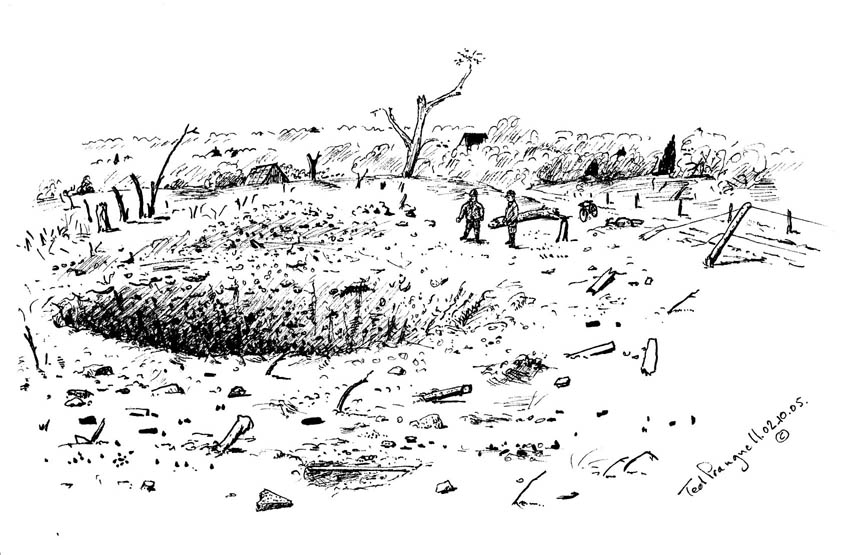
    When cycling to school, on the 23rd. of February, 1945, I had reached as far as Ash-Platts bridleway unscathed. I am sure there is such a thing as a premonition.  Roughly half way across the Ash-Platts, there is (or was) a sharp little hollow that one had to pass through.  The path made a dip down, and then there was a short climb out of it - under an umbrella of beech trees (which were still wearing their light winter coat of a few brown leaves); when I felt a strong sense of unease.  A few minutes later, when I emerged out of the wooden kiss-gate, crossed the A25, and had just started up Seal Hollow road, when I heard a colossal bang from behind me.  I could see nothing from where I was, so I carried on to school.  Later on in the day at school, there was talk that a V2. had fallen near Seal, and that the Number 9 bus from Maidstone had had its windows blown out.  I do not know how exactly true that was.  However, cycling home after school that afternoon we returned via the Ash-Platts as usual.  When we arrived at the half-way point, that of the hollow along the bridleway, we came upon a scene of some devastation.  A V2. had made a deep crater, just to one side of where the Ash-Platt's pathway had been.  We had to circumnavigate the area through a garden to regain the path.  I believe that one man, who had been in the garden,was killed.  Whilst the crater was large, surprisingly, the surrounding area was not as badly affected as we were becoming used to expect from a flying-bomb.


A V2. had made a deep crater

    I have already mentioned the V2, which devastated houses in Wickenden Road, St. John's, Sevenoaks, and killed 9 people. Perhaps the ground was harder there, because the crater was smaller, the damage was extensive.  The V2 traveled at super-sonic speeds (well over 3000 mph.), and they carried one tonne of explosive.  If one fell on your foot you really did need to have your fingers in your ears!

DUMMY AIRFIELD
    We were cycling along the A225 from Otford to Shoreham, when I spotted some aircraft haphazardly parked in a field (roughly where the cricket field later was sited).  It seemed to my young mind a strange place to have an airfield.  There were tall trees all around, and the ground sloped a lot.  We soon twigged on that the planes were dummies.  This was supposed to be a dummy airfield to confuse enemy bombers - we weren't so easily fooled, nor apparently were German bombers.

GERMAN AIRCREW'S GRAVES
   Some German aircrew were buried in Seal Church's graveyard.  The graves were marked with crosses, which bore their names.  The bodies may have been transferred elsewhere after the war, because I don't think they are there now.
Note from Len Barton (of Wingham): Many of these graves of German casualties, as have been located; have been re-buried with full military honours in the German Cemetery at Cannock Chase.  The ground(s) are now officially recognised as German soil.

LORD HAW HAW
    "Germany Calling. Germany Calling"!  I remember we were opening our Christmas presents when someone in the family tuned into 'Lord Haw Haw' on our radio.  He was saying what a bad time we were having, and spoke about all the things that we couldn't get, when my Auntie Peggy opened her parcel, which contained a pair of 'silk stockings'; she jumped up, danced about, and waved them about triumphantly; defiant at the voice coming from the radio. We all laughed, deriding 'Lord Haw Haw'.
[Note from Len Barton: Joyce - who was arrested after the war, was tried, found guilty and hanged as a traitor in the Tower of London].

THE BBC. And Radio Entertainment
  There was no Television.  We had a Murphy-Richards valve radio.  This was large with a wooden case.  As far as I can remember there was only one radio station, and that was the good old BBC.  The news bulletins were very important to us, and we were very familiar with many of the war correspondence, including Richard Dimbelby, and John Snag.
    We always listened Churchill's speeches. I think he did inspire the nation at that time. Just when such inspiration was desperately needed.

The BBC's children's programme (Children's Hour) was at 5. pm. Introduced usually by Uncle Mac. I remember 'Toy-Town' and Larry the Lamb. The latter was a bit juvenile, but we still used to listen to it.


   There were many comedy programmes such as ITMA. ('It's That Man Again). Variety programmes, and some excellent, and exciting serialised dramas; such as: The 39 Steps by John Buchan, and Paul Temple by Francis Durbridge, and the 'Man-in-Black' with that eerie spooky voiced actor: Valentine Dyal.
Also famous were singers: Vera Lynn (we'll meet again…) the 'Forces Sweetheart', Gracie Fields, and a host of other entertainers. Good comedians and comedy programmes. We certainly didn't go short of humour on the radio.  Most performers used to go off and entertain the troops.
     Desert Island Discs (Roy Plumley?), and the "Forces Favourites", which was introduced by Cliff Mitchelmore and Jean Metcalf. There was a weekly variety programme called "In Town Tonight".

INCIDENTALS
    There was a large army training camp above Wrotham in Trosley Park. My Father's cousin, Louis Bannister, was stationed there for his officer-training course. He 'marched' from there the 5 miles to our house in his very smart lieutenant's uniform, with Sam-Brown belt and everything - I was most impressed. Then after he had a meal with us, he had to march all the way back to his camp.
Later, my uncle visited us with his 'new' fiancé. They arrived at Otford Railway Station.  My mother walked all the way to the station to meet them, which was a distance of about 1½ miles, pushing an old pram.  The purpose of that, pram was to be able to carry the couple's luggage, which included a suitcase, on the walk back to our house.  There was no taxi service then.
I believe that the first Taxi in the area, and certainly in Kemsing, did not materialise until the early 1950s, when a Mr Chapman, who lived in Dynes Road started running one, a large black (Virtually all cars that there were then were black) Austin 16 saloon. Not many, if any families would have owned a car in Dynes Road at that time.

John Hilder - Myself and Monty (my cat) - Derek (my brother)


John Hilder - Myself - Derek - David Bridge 
Standing outside Knole House main doorway 
    I can distinctly remember, that when this picture was taken (which I think was taken by my father),  I refused to straighten my school cap.  I had this idea that wearing it at a 'jaunty' angle created a more macho-image.  Perhaps I was years before my time! The cap was the only item of the preparatory school uniform that I wore, though we wore dismal grey thick cotton shirts. Later they introduced a blazer, and a breast pocket badge.  Short trousers were worn to school, throughout the year, at that age; regardless of the weather.  John Hilder, and Derek were 3 - 4 years older, and old enough to be wearing long trousers.
    My brother is wearing a lumber jacket that my mother made out of a blanket.  I had a similar one.  David Bridge was our next-door neighbour, but one, and we were about the same age.   He went to St. Michael's School.  A sign of those times, sadly, was that his father died of TB. His next-door neighbour was Rex Duval. His father (Mr Duval) also died of TB. at around about the same time.
    John Hilder's father had the butcher's shop in Plumstead (South east London) that took our rooks to sell, and many of our rabbits.  My cat 'Monty' was named after General/Field Marshal Montgomery (Ironically, many years later my sons had a pet rabbit each, one of which they named Rommel).
    One of the pupils at the Preparatory School contracted Polio (David Brown).  When this was discovered, the whole school was shut down, and we were all sent home immediately.  Which, for us, was great for we had an extra long summer holiday.  The Polio Virus has almost been wiped out since then.  Fortunately that boy made a good recovery, and he is fit and well today (2004).


CHRISTMAS & DECORATIONS
    We cut up strips of newspaper to make paper-chains, making the glue out of flour and water.  Sometimes we were able to get the coloured strips of paper.  My mother made what she called a 'Mistletoe" out of newspaper and a wooden hoop (gained form redundant, or damaged butter barrels), to hang on the front door.  If we were sometimes lucky we managed to get hold of plain coloured crepe paper.  We didn't have a Christmas tree. We would cut a few branches of a yew tree and bundle them together to make the best Christmas tree we could out of it.  The decorations for it, and around the house had to be mostly home made. Such as walnuts, and fir cones. Nobody had any Christmas lights!

THE END OF THE WAR
    Whilst the general feeling was that people were pleased and relieved that the war was over, I had hardly known anything else in my life, other than a wartime environment.  Most of my war experiences at that age, had been of excitement, tinged with fear from time to time, and if it hadn't been for the V2. Rockets I would have been quite happy for the war to have continued. I thought: "Oh dear", the end of the war would mean that there would be: no more: soldiers, military vehicles, or aircraft dogfights. Had we been on the losing side, and had I been older, then my feelings would, no doubt, have been rather different. Now, with hindsight and greater experience of life, I am very glad that I wasn't a parent, or an adult, during that time.
   I remember hearing the sound of church bells being rung, which was a first time for me. However, on VE. Day we went up the hill, and carved the date, and the words: "VE Day" into the bark of a large beech tree, just off Chalky Lane, to mark the date. I remember that the bark was very hard. A Mr Webber, an elderly gentleman (a retired mariner) who lived in a bungalow two doors down the road. I vaguely remember that his son was in the Navy, and that they named a grandson 'Rodney' after his father's gallant ship: HMS Rodney. Any way, it was Mr Webber who gave me his ex-naval services jack-knife (of which I was very proud), which we used to carve the tree (it was a beech, and the bark was very hard).

AFTERMATH
    Kemsing Railway station was always well kept, with flowerbeds and roses, etc.. What went unnoticed by most rail travellers was, that whilst they might have observed, and appreciated the hanging flower baskets, that at least one of them was made from a WW2. British Army helmet. It was still there in the 1960s.
    We quite often used to cycle down via Noah's Ark along Honeypot Lane to Kemsing Station.  Although it was in an isolated position, quite a lot of goods were delivered to that station by rail, and stored in the goods-shed.  We used to go there to watch the goods wagons, and coal trucks being shunted (by a steam Loco).  There were sidings, and quite a sizeable coal depot there, in those days. We also stopped off to lay a penny or two on the rails at the farm level-crossing part way along Honeypot Lane, then retrieve the flattened results on our way back.
    The following tale was related to us (Or the gist of it was): in the 1960s, by a certain Mrs Ashdown, of No. 4 Whatcot Cottages. The cottages, which were situated on the A25, in Platt (St. Mary's Platt, near Wrotham).
     A German bomber crashed between Borough Green, and St. Mary's Platt (Near Wrotham, Kent). The local policeman became involved as members of the crew were killed or died. It just so happened that the policeman's wife, Mrs Ashdown was born in Germany, and hailed from Bavaria.  She was drawn into the affair, because she was German speaking, and became involved in examining the crew's documents that had been recovered from the crashed plane.  Upon examining their papers, she discovered that, by a very remarkable coincidence, she had in fact, at one time, lived in the same building/ block of flats, in Germany, as one of the members of that crew!  I.e.: She knew him. She took it upon herself to write to the relatives of one of the deceased, a letter of explanation of the circumstances, and to offer her condolences.  I believe this was sent through the auspices of the Red Cross.
    Apparently, Mrs Ashdown eventually received a reply.  To her astonishment, it seemed that their main concern of the deceased's relatives was that 'Hans'* had owned an expensive pair of Zeiss binoculars, and they thought that he would have been carrying them on his person during the raid.  The important question they were asking was: "What had happened to his binoculars?"
*The name 'Hans' is concocted.

CHILDSBRIDGE LANE (Kemsing).
    Our house was built in 1930, and it was one of the first houses to be built in Childsbridge Lane.  On either side of the lane, and of Dynes Road (then a just a dirt track), there were just open fields.  The Lane was widened in (about) 1939.  The original (sunken) lane was an ancient sunken lane that ran under where the footpath, on the Kemsing side, now is, i.e.: between the telegraph poles.  To get into the '100 acre' field we had to climb up the bank and get through the hedge.  That lane was filled in, and the present footway was built on top of the old lane. I can remember all this work being done.  As a result of the road level being raised, part of the drive into our house had to be filled in, and raised to meet up with it, and it was then resurfaced.

    We didn't have such luxuries as: a dish-washer, fridge, deep-freeze, microwave, spin-dryer, electric-iron, but we did have a 'COPPER' and a mangle.  The 'Copper' was out in our small lean-to greenhouse (Conservatory) at the back door. Our washing was done in the Copper. The 'Copper' was a large inverted bell shaped tub, which sat in a cast-iron casing.  There was a space between the tub and the outer casing, which allowed heat and smoke to circulate; for, underneath the tub was a little fire box. A fire was lit to heat up water in the tub.  It took quite a long time to heat any volume of water. Coal was rationed, and in short supply.  This was another reason why we boys always brought wood down from the hills, even in Summer time.  The smoke went out from the back of the copper unit via a metal pipe, or chimney, through a hole the green-house wall and up the side of the greenhouse wall and out to atmosphere.
    I can't remember what my mother used for washing 'powder', but I do remember large blocks of 'Sunlight-soap'.  There was a wooden lid to the copper, and we had a wooden pole to stir, and pummel the washing.  Of course there was no nylon then, only wool and cotton, nothing was drip-dry. So we had a wringer to squeeze the water out, and a 'Flat-iron, which was nothing like as good as a spin-dryer of course. The iron was heated by the open fire, and we made toast that way too, using a toasting fork. So we didn't have toast that often, especially in the Summer.
   We had didn't have any Cereals, except the occasional 'Porridge' (milk was Rationed, don't forget).  We sometimes had lard or 'dripping' to put on our bread.  We could make our own jam, (providing we could get the sugar) and we used to 'bottle' (Preserve) fruit. All that fruit would be locally grown (especially plums), or collected from hedgerows, such as blackberries, and damsons. Preserving, other than as a jam, was done in Kilner jars.  These jars had a rubber seal, which was only supposed to be used once, and then thrown away, but since these seals (being made of rubber) were very difficult to obtain, they were reused. However there was some risk in this, in that the seal could fail.  A failed jar seal could mean that the contents would quietly start to ferment tucked away out of sight in a cupboard.  That is, until the pressure built up and it exploded. The resultant mess was dreadful, and a major cleaning up operation was then necessary.  We so once had a bottle of homemade Ginger-beer which exploded! What a mess that made Carrots and potatoes were grown in our garden, and we stored what we had spare, by immersing them in sand, in second-hand plywood 'Tea Chests', which was kept in our garage. People also made 'clamps' to store potatoes in, or try to.  It wasn't always very successful.  There was no exotic fruit like Bananas, oranges, dates, etc.  All was locally grown and in season. But we gathered hazel nuts, and chestnuts, which we roasted on the open fire. We grew tomatoes too, but usually finished up with green (unripe) ones, with which we made chutney.
    Occasionally, we might find some largish field mushrooms.  If they were partially nibbled, especially those found in a sheep field, we felt that this was a sign that they were save for us to eat too.
    All this was largely a very much a combined mother and child activity, as our father was rarely at home, and abroad for at least two years of the war anyway.
    My much older aunt who was one of eleven children said that all she ever got for Christmas was, an apple, and orange, and a new penny (old money).  I am not sure that she was right about the 'orange', because I didn't see an orange until after the war.
Meats were in short supply. So one can see how important to us the rabbits we caught were. A lot of people kept chickens, for their eggs and meat, even my Aunt and Uncle did in their very small garden in London.  Dairy produce was rationed.  Eggs were sometimes pickled for storage, but this wasn't very successful.
    We ate 'Bubble-and-Squeak' (mashed potatoes and cabbage, all mixed up together), and enjoyed it.
     In our house, there was no central-heating, no double-glazing, and poor insulation.  My father had lined the loft with plywood panels produced by breaking down old tea chests. We had electric blankets.  'Rubber' hot-water-bottles were scarce; we had a (one only) horrible hard stone one, which you had to be careful not to knock your ankle against when tossing and turning in bed.
    We couldn't be fussy over our food.  We ate what we were given.  We didn't think that life was particularly hard, we didn't know any other, but I cam imagine the modern children would find it very hard today if they were suddenly introduced to this way of living.
    At the time of writing, John Hilder still lives in Kemsing, in Dipper's Close.

    My wife and I were married in St. Mary's Kemsing Church in September, 1959, and our first home was in St. Mary's Platt.  My wife is German by birth, and her, and her families war time experiences were far more traumatic than ours had been.
    Heverham (this is, I believe, the correct spelling) was a proper farming hamlet in those days; with the smell of farm animals, and straw blowing, and lying about the place.  Almost everybody that lived there worked on the land in one way or was associated with it in one way or another.  It had a forge. On occasions I visited the forge and watched horse being shod.  It had a quite differenthomely atmosphere then, to what it has now.
What struck me most when I returned to Kemsing recently, was the extraordinary number of cars cluttering up the village.  Cars were few and far between in my school days, especially out in the villages, yet people seemed to manage very well without them. If you went down to the village, I doubt if we ever saw a car all the time we were there.


AFTERTHOUGHTS

MULTIPLE PILE-UP. 
    I can't put a date to this incident, it may have been after the war. At this time it was long before the M20 motorway had been built, and there was a simple crossroad junction. The A227 passed through Wrotham village as the High Street, and it continued straight up the hill over the Downs as the Gravesend Road. This was a renowned accident Black-Spot.  A convoy of (I believe) fourteen army trucks was descending Wrotham Hill on the A20, when, just as the leading vehicle came up to the traffic-lights, they changed to red, and it stopped.  Fourteen army vehicles ran into the back of each other.  I vaguely remember that a picture of the incident appeared in the Kent Messenger.

UNDERGROUND CHAMBERS.
    We would sometimes go into the woods that lie between Chalky Lane and Row Dow, above St. Michael's School.  Once we went with my Mother to collect blackberries.  We were aware that, technically, it was a private wood (there was a sign to say so), but we still went in there to collect firewood or chestnuts in the autumn.  However, this time we were 'caught', by a man who was wearing a trilby hat.  He gave my mother a telling-off for trespassing.  We weren't doing any harm, and I can remember my mother telling to him that he was a 'little Hitler'.  The ultimate insult!  He didn't like that at all!  I was quite shocked that my mother could say such a terrible thing.  But, I thought that the horrible man deserved it. But, 'Hitler', now that was pretty strong stuff!
    Us boys, on our own, found our way through the chestnut woods to Rowdow Hill. There was an overgrown track that led to a gate into the road at Rowdow.  Near this gate we found some manholes in the wood.  We lifted these manholes to expose some huge, and deep, underground chambers built with concrete.  There were vertical iron rung ladders, and we climbed down into these chambers.  They were deep and huge.  The only light came from the tiny rectangular manhole openings above.  It was cold damp and rather scary. There was little or nothing to see having climbed all the way down there.  We didn't know what they were used for at the time, but they could have been an empty reservoir.  They were our secret, but of course some adults must have known about them.  However upon reflection now, it was a dangerous thing for us boys to do, totally unsupervised, in an isolated spot, miles from home. 

ARNHEM.
    I can just remember large numbers of aircraft flying overhead (due east wards) during the day, and that several of them were towing gliders. I remember thinking, at the time, that gliders weren't much good, 'you can't fight with gliders'!  Could it have been part of the Arnhem offensive I wonder?
    I have traveled quite frequently to Germany for many years now, often by car. However, now, when I pass, or go through places like: Arnhem, Essen, Dusseldorf, Hamm (Famous for its huge railway marshalling yards), or cross the Rhine Bridge, all these names remind me of places, which are so familiar to me, because they featured as front line news on the BBC.'s News bulletins during the war.  Particularly as bombing targets.  I have also been to Dresden in 1998 and seen the see of tower cranes, which were part of the huge rebuilding programme.  Dresden was a beautiful city, which was devastated by allied bombing during the war.  When we were there not long after the reunification the cathedral was just a heap of rubble.  Only this Year (2004) the main structure has been rebuilt, financed by donations from all over the World.  The copular was made in England, and the cross, were donated by the people of Britain.

E.W.S. (Emergency Water Supply)
    In most built up areas, often on bomb-sites, large tanks were constructed, which were designed to contain water.  Mostly for fire fighting purposes. These often her identified with large signs: "E.W.S.",

ADVERTISING POSTERS.
   There were a few about,  hardly any commercial ones, but I think they would have been displayed mainly in large towns and cities.  I remember "Dig For Victory", and the "Squander-Bug".  You can't imagine that in this day and age!  When Squandering goes on everywhere now!

   Some signs of the war still remain, such as this 'Pill-Box', which is situated on the Royal Hythe Military Canal bank at St. Rumwolds Church, on the edge of Romney Marsh. There are several about, including one in the village of Pluckley.  I have photographs of several of them.  There are a lot of concrete Tank Traps still; about, one example is near Howletts Zoo at Lympne.


Some signs of the war still remain ...
WW2 Bomb Craters Some sixty years or so (2001/2) since the Battle of Britain, and the Blitz, little evidence now remains to indicate that Kent was an aerial battleground, or that any bombs ever fell on the county.  Craters have been filled in, over the years they have become overgrown, and bomb damage to property has long since been repaired. But there is the odd exception as this photograph can demonstrate:-


WW2 Bomb Craters
In this photograph (taken in late December 2001), on the distant hill slope,one can see  what looks like, the relic of a W.W.2 bomb crater, and there is possibly a second one, which is less well defined just above it, and slightly to its right. The shadows cast by the low angle of winter sunlight highlight the depression caused by a bomb. The location of this particular crater is on the North Downs, near Coombe Manor, Wye.  Quite a lot of bombs appeared to have been dropped randomly way away from any meaningful target, as were so many on the Downs above Kemsing.  In this instance, it may have been dropped by a bomber, which was trying to lighten its load in a case of an emergency.  Or, it was poor navigation and targeting; or, possibly because of poor visibility due to inclement weather, which would be worse on a dark night.  Sometimes dummy fires were lit on the ground to draw the bombers away from real targets.  Another possibility could have been (And I'm sure it happened), that the bomber's crew decided to take a "Let's drop our bombs any old where, and get the Hell out of it, and head for home to safety as quickly as possible" attitude. Who knows?  There could also, of course, have been a legitimate target in the area at the time.

TROLLIES.
    We used to construct trollies out of salvaged materials. Floorboards could be gleaned from bombed out premises, and oddments of timber.  Things like nails we recycled from where we could get them, and straighten them out.  Obtaining wheels was a problem. It wasn't even easy to get lubricating oiI. I know we got some from pram, or two, that we found in an tip/old rubbish pit that was in the corner of a filed south of Gore Hill Farm. A bent nail had to make do for a split -pin.
    We used to have races down Childsbridge Lane, which was quite wide and straight.  The larger, older boys used to invariably win, because they were heavier. Now, you can't imagine anyone doing that today, because shear volume of traffic just wouldn't allow it: - it would be far too dangerous.  In the winter snow, we had our home built sledges. If we were lucky we got hold of metal runners form the base of a Morrison shelter, or wherever.  That was O.K., until some rotten so-and-so would spoil things by putting down ashes from fires to provide a grip for the odd vehicle, or horse and cart, that did happen to come along.
    There were virtually no fathers around to help us make these things, because they were away in the war, or on some war duty. So it was a case of : "D.I.O." (Do it ourselves!).

SECRET SIGNALS.
    If we were up on the hills, and we were looking for a friend, then we would make our call of a Pewit.  That would let them know that we were approaching, and they could confirm where they were from the direction of the sound.  Also if you heard anybody moving about in the woods, you could check who they were, without actually seeing them.

UNEXPLODED BOMBS
    There is 'nice' one on display in Chatham's town centre.

DIRECTION FINDING
    As you will by now know; road/direction-signs were all removed.  There were a lot more individual pubs about then than there are now.  They had a variety of names, so people could navigate, and give directions using public-houses for identification.
    For example :~
    "Turn left at the cross roads, then go straight on from there. You will come to the Wheatsheaf, and the Bell. Keep straight through the village until you reach the Fox and Hounds Fork left, and then keep straight on up the hill until you reach the Rising Sun, at the next cross after the Rising Sun, turn right, and so on……………

Notes:-
HMS. Kelly:
   More very interesting, and exciting, information about the Kelly can be obtained from the web-site:- www.hebburn.org..uk/pages/kelly.htm
Sevenoaks Prep. School has been relocated at Godden Green (TN15-0JU) since 1968.
Ref:< www.sevenoaksprep.sch.uk > and staff@sevenoaksprep.kent.sch.uk/alumini (School Magazine?) and headmaster@sevenoaksprep.sch.uk St Michael's School's e-mail address is : ~< office@stmichaels.kent.sch.uk > There is a publication called "The Pitkin Guide, and their : ~ 'Britain in the Blitz' this carries pictures of the Morrison Shelter, and an Anderson type.  The publication also has an item about ladies painting their legs (no ladders in those 'stockings'), and it has an illustration of a Ration Book, together with a list of how a weekly ration was made up during 1941. Ref.: www.britguides.com

Acknowledgements
    Len Barton (Wingham), for a his part in doing a bit of proof-reading of the first edtion, and providing some information, and advice.  He served an Officer in the Home Guard (East London "Z" AA. Rocket Battery).  He was also a POW prison guard, and who maintained friendly contact with several 'his' German prisoners.
    Keith Chrystal (New Romney), for letting me read his interesting WW2 memoirs, and for providing me with information about the Big Bertha, the huge Rail-born Gun. 
    Mike Ellison for confirming some of the information about Hebburn-upon-Tyne, near Newcastle:- e-mail: hebburn@blueyounder.co.uk Q.E.D. (as at 20th. April 2001), and subsequent revisions.
     Ed Thompson, Otford's Local Historian; for supplying pictures.
     Brian Mock for Tenterden the picture of the Mid-wife's Austin 7.
     Dr. Imola Mavity (Linguist and art historian) for help in establishing this blog.
     Steve Nueman as IT consultant.